
Lisbon Metro
Lisbon Metro
Contents [hide]
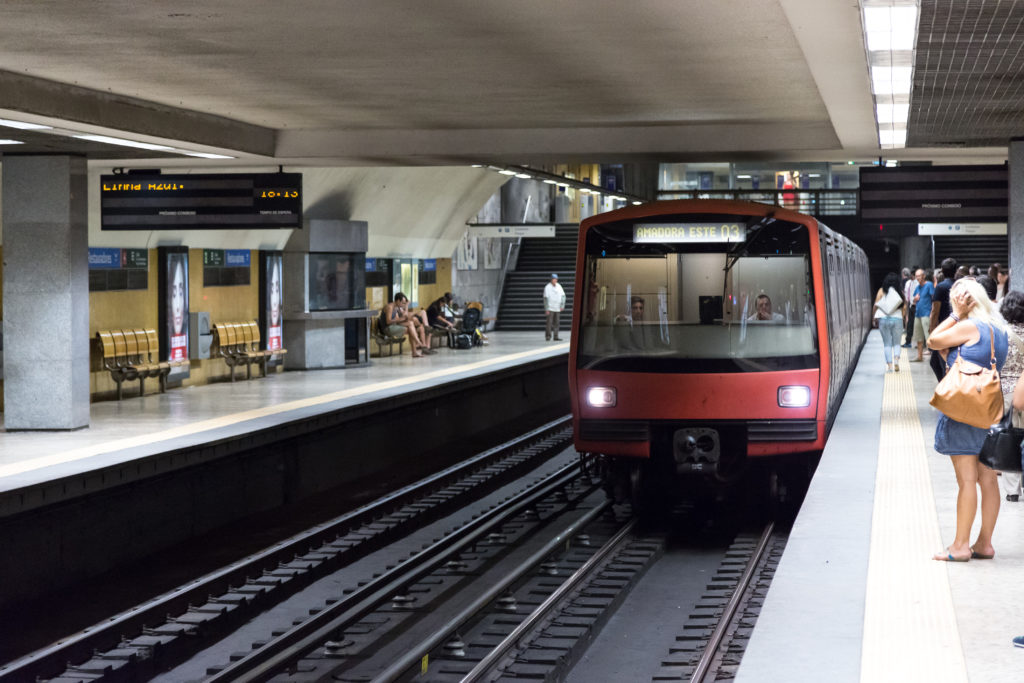 Lisbon Metro ©Sergii Figurnyi – stock.adobe.com
The Lisbon Metro: essential information for travelers, including details on the closest points of interest to each station (where to stay, what to see, etc.)
The metro has four (4) lines: the blue, the yellow, the red , and the green. Further down you'll find a map showing all the lines and their routes.
Hours
Open every day from 6:30 AM to 1:00 AM. On Saint Anthony's Day (June 13th) it usually runs later, sometimes until 4:00 AM. Extended hours are also in effect during major international festivals and football matches.
Ticket Prices
The price per metro ride in Lisbon is €1.40
Card with Single Trips
To use the Lisbon Metro, your best option is to purchase one of the available travel cards, either the "Viva Viagem" or the "7 Colinas". The initial purchase costs around €3.30 (two trips — there and back — plus the €0.50 card issuance fee). It's valid on buses, trams, the metro, and trains. trams
Card with Zapping Mode
You can also load money onto the card in Zappingmode, starting from €5. You top up credit and it's deducted as you travel. The advantage is that depending on how much you load, you receive a small bonus, and each trip is charged at €1.25 instead of €1.40. If you choose this option, the card can only be used in Zapping mode from that point on.
Daily Ticket
Finally, with tourists especially in mind, there is a "daily ticket" option. It costs €6 and gives you unlimited travel for 24 hours.
You can also purchase the Lisboa Card , which not only gives you free access to certain transport options, but also free entry to many attractions and discounts at others, as well as free train rides to Sintra or Cascais)
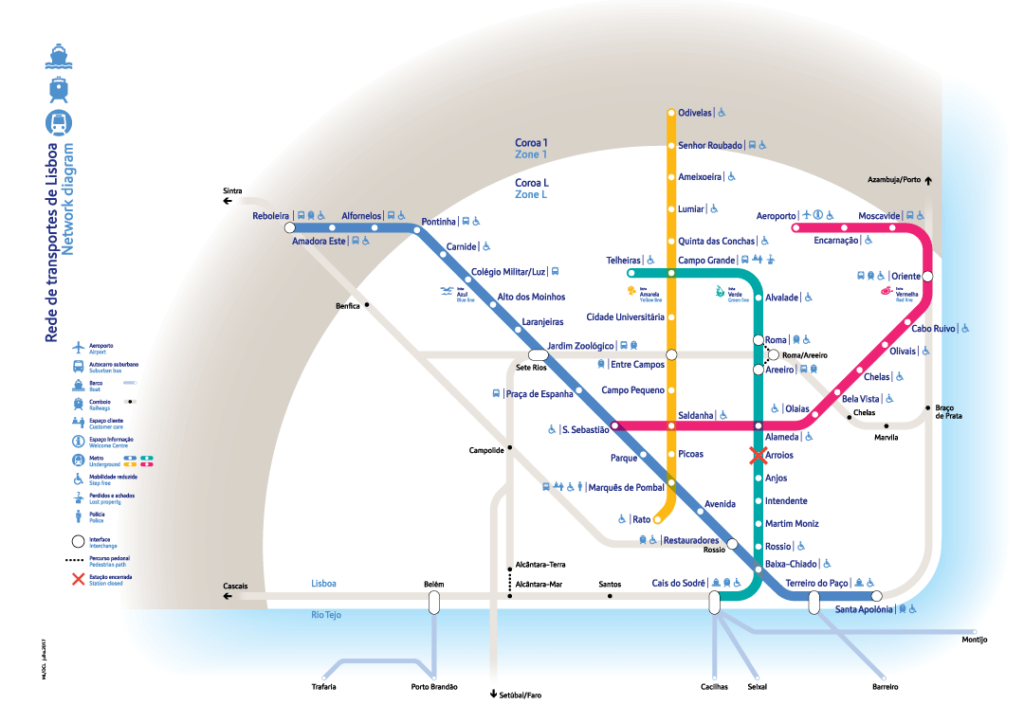
Lisbon Metro Map
Here is the diagram and Lisbon metro map. Click on the image to view it larger.
Blue Line
The blue line is useful for those exploring the city center; its stations at Santa Apolónia, Baixa-Chiado and Rossio are the most interesting for tourists. Its terminal station, Santa Apolónia, connects with trains heading to northern Portugal, to cities such as Porto, Aveiro, Coimbra, and other cities. This line runs from Amadora Este to Santa Apolónia.
A journey along the blue line of the Lisbon Metro includes the following stations: Amadora Este, Alfornelos, Pontinha, Carnide, Colégio Militar/Luz, Alto dos Moinhos, Laranjeiras, Jardim Zoológico, Praça de Espanha, São Sebastião, Parque, Marquês de Pombal (connects with the Yellow Line), Avenida, Restauradores, Baixa-Chiado (connects with the Green Line), Terreiro do Paço, and Santa Apolónia.
Yellow Line
The Lisbon Metro yellow line runs from Odivelas, in the north of the city, connecting southeast and ending at Rato station. This line passes through the city's financial district, where you'll find Marquês de Pombalstation. Other stations of tourist interest include: Campo Pequeno for the bullring right outside the station, Cidade Universitária for a visit to the University of Lisbon, the Quinta das Conchas, and Rato, as an upscale area of the city with nearby attractions such as the Lisbon Botanical Garden.
A journey along the Lisbon Metro yellow line would take you through Odivelas, Senhor Roubado, Ameixoeira, Lumiar, Quinta das Conchas, Campo Grande (connects with the Green Line), Cidade Universitária, Entrecampos, Campo Pequeno, Saldanha, Picoas, Marquês de Pombal (connects with the Blue Line), and Rato
Red Line
Three new red line stations are already in operation: Moscavide, Encarnação, and Aeroporto. The latter expands the options for choosing how to get from Lisbon Airport to the city center.
The Lisbon Metro red line connects to the northwest of the city from S. Sebastião station, reaching all the way to Orientestation, one of the city's important architectural landmarks in the Parque das Nações. This line acts as a connector with the rest of the city's lines, linking with all three — the blue, green, and yellow — at various points. Its terminal station at Oriente is considered one of the most beautiful on the Metro and is also home to one of the most important bus and train hubs in the city.
A journey along the Lisbon Metro red line would take you through S. Sebastião (connects with the Blue line), Saldanha (connects with the Yellow line), Alameda (connects with the Green line), Olaias, Bela Vista, Chelas, Olivais, Cabo Ruivo, and Oriente.
Green Line
The Lisbon Metro Green line is the second largest line in the city (after the Blue line). It completes the circuit of central Lisbon alongside the Blue line, serving tourist highlights such as Rossio, Baixa-Chiado and Cais do Sodré.
A journey along the Lisbon Metro Green line would take you through Telheiras, Campo Grande (connects with the Yellow line), Alvalade, Roma, Areeiro, Alameda (connects with the Red line), Arroios, Anjos, Intendente, Martim Moniz, Rossio, Baixa/Chiado (connects with the Blue line), Cais do Sodré.
Finally, we leave you with the official Lisbon Metro network map.
Now that you know how to get around on the Metro, why not find out what the must-see attractions?
are? Its network more than meets the city's transport demands, and on the longest journeys travel time can be between 45 and 60 minutes. That said, considering the places of interest a tourist needs to see, it is very rare for any visitor to spend more than 20 minutes travelling between one point of interest and another.
In general, Metro stations are safe and are usually well maintained, organized, and clean. Inside the stations it is common to find staff you can ask for directions, information about points of interest, and more.
It is very common to see beggars on the Metro, as well as artists and musicians who put on excellent performances — particularly a blind gentleman who creates rhythms with a metal rod, a tin can, and other objects as he walks through the carriages.
More ways to get around Lisbon
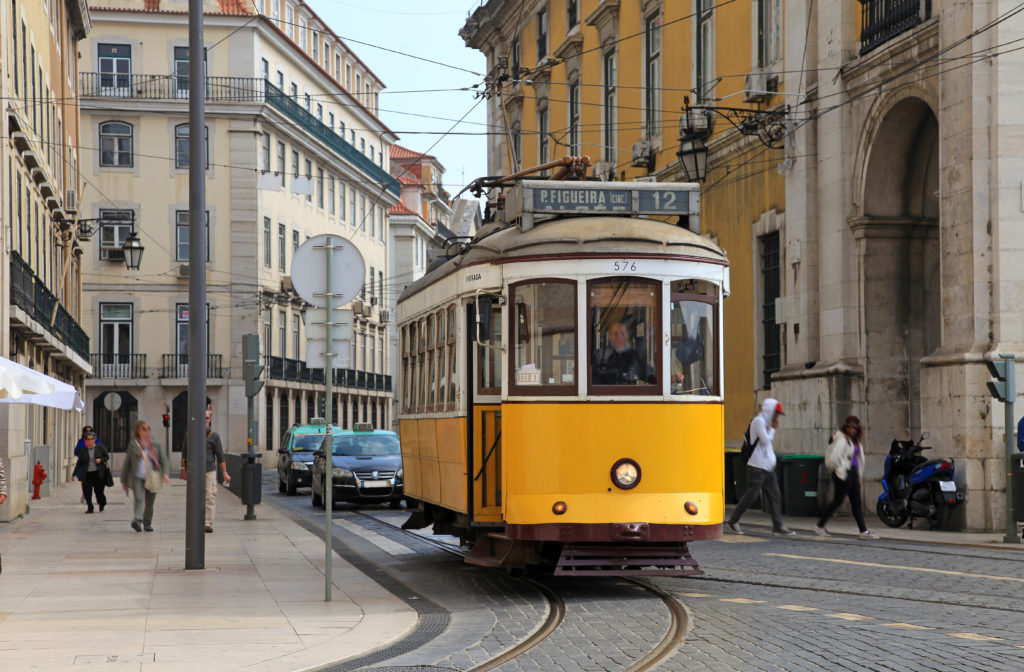
Lisbon Trams
Classic trams like the iconic Tram 28 and modern trams to reach Belém.

Lisbon Airport
Find out how to get between Lisbon Airport and the city centre.
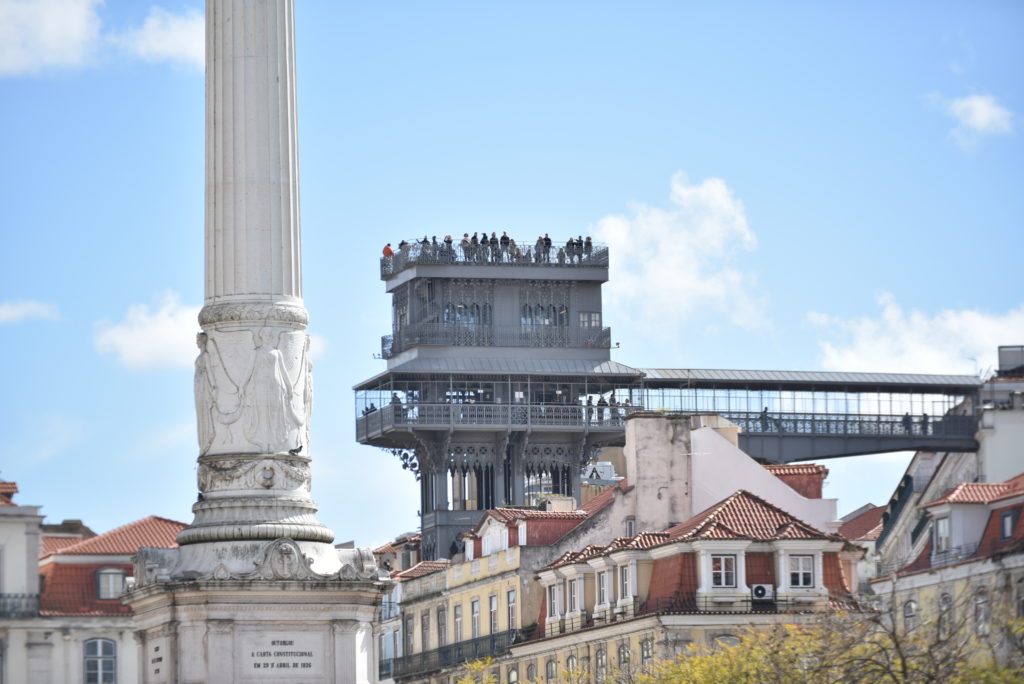
Santa Justa Lift
Skip the hill by riding this classic Lisbon lift.
